
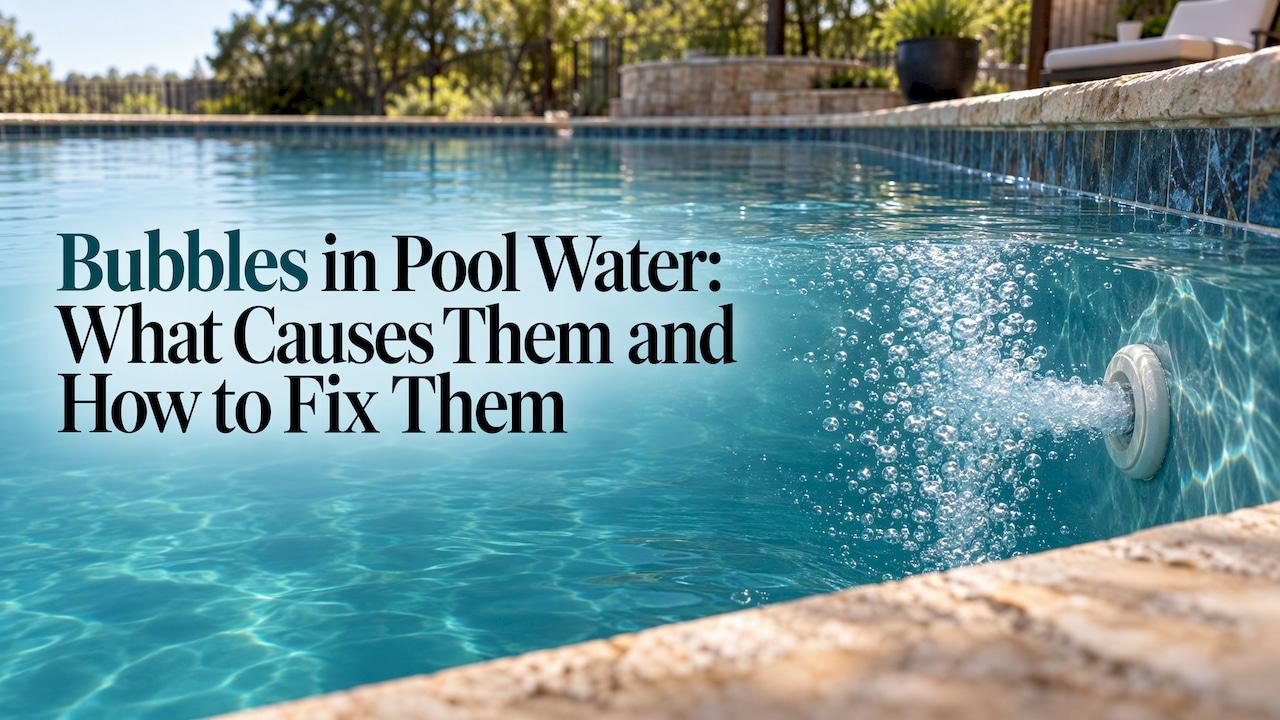
Bubbles in pool water come from one of two places: air getting into your plumbing, or foam forming on the surface. A few bubbles when the pump starts are normal. A steady stream of bubbles from the return jets usually means air is leaking into the suction side of the pump. A layer of frothy, lasting foam on the surface usually means something in the water is lowering its surface tension. Each problem has a different fix, and the first job is working out which one you have. If you would rather not trace it yourself, our on-site diagnostic is $99 and covers the pump, the plumbing and the water.
TL;DR
- Bubbles that fade within a few minutes of the pump starting are normal. Bubbles that keep coming from the return jets point to an air leak on the suction side.
- Common leak points are low water, a stuck skimmer weir, a worn pump-lid O-ring, loose unions and valve fittings.
- Foam that sits on the surface is usually a contaminant issue: body products, detergent residue, or too much algaecide. Chemicals will not fix an equipment leak.
- Test your water before adding anything. Balanced water with adequate chlorine keeps organic load under control.
- Our $99 on-site diagnostic finds out whether it is air, foam or both, and our weekly service keeps the water balanced so it stays that way.
Table of Contents
- First, work out which kind of bubbles you have
- Air bubbles from the jets: a suction-side leak
- Foam on the surface: a water problem, not an air problem
- Test before you treat
- How to get rid of foam
- How to find and fix an air leak, step by step
- Normal bubbles you can ignore
- Why a weekly service keeps bubbles from coming back
- Our approach in Austin
- FAQ
- Sources
First, work out which kind of bubbles you have
People search for "air bubbles in the pool," "foamy water," and "bubbles coming out of the jets" as if they were one problem. They are not. Two questions sort them out.
Where are the bubbles?
- Coming out of the return jets, or visible in the pump basket: this is air moving through the system. It is an equipment issue.
- Floating on the surface, collecting along the walls or at the skimmer: this is foam. It is a water issue.
When do they appear?
- Right after the pump starts, or after a backwash: air trapped in the lines is working its way out. This is normal and should clear in a few minutes.
- All the time, even after the pump has run for a while: something is pulling air in.
- Hours after you added algaecide or after a busy swim weekend: the likely cause is foam from the water itself.
A simple test: run the pump for ten minutes and watch the return jets and the clear lid on the pump basket. If the pump basket is full of water with no bubbling, and the jets are quiet, your bubbles were ordinary. If you see a steady stream of tiny bubbles or a basket that looks half empty and frothy, read the next section.
Air bubbles from the jets: a suction-side leak
Your pump pulls water from the skimmers and main drain, pushes it through the filter and heater, and sends it back through the returns. Any gap on the pulling side of the pump lets air in along with the water. That air is carried through the system and comes out of the return jets as a stream of bubbles. The California Pool Association says excessive bubbles from the returns, loud churning or grinding, and air near the pump usually point to air infiltration.
Pressure-side plumbing, after the pump, tends to show up as water leaking out rather than air getting in. So when the symptom is air, look before the pump.
The usual suspects
The same short list of causes accounts for most cases. The California Pool Association's checks line up with the points below.
- Low water level. If the water drops below the skimmer opening, the skimmer pulls in air along with water. In Austin summers, evaporation can lower a pool noticeably within days, especially with wind and a heater running.
- A stuck or jammed skimmer weir. The weir is the small floating flap in the skimmer. If debris jams it, the skimmer cannot draw water properly.
- A worn or dirty pump-lid seal. The O-ring under the strainer lid dries out, cracks or collects debris on its sealing surface. A lid that is not tightened fully has the same effect.
- Loose unions and fittings. The threaded connections around the pump can loosen over time with vibration and heat cycles.
- Valves and drain plugs. Valve stems and the pump's drain plug seals can let air in without leaking visible water.
Any one of these can produce the same symptom, which is why guessing is slow. You can swap a lid O-ring and still have bubbles because the real leak is a loose union or a valve stem.
Is it bad to run the pump with air in it?
Yes, over time. Air in the system means the pump is not moving the water volume it should, so circulation and filtration both drop. A pump that is pulling air can also run loud, with a rumbling sound. Pump seals rely on water for cooling and lubrication, so a pump that keeps running with air or low water gets extra wear. A leak you can fix in minutes today can turn into a repair bill later. If the bubbles are constant, do not leave the pump running for days while you decide what to do.
Why bubbles in the pump basket matter for your water
Weak circulation affects more than the pump. Water that does not move through the filter and past the chemical feed does not get cleaned properly, and in Texas heat that can show up as haze or algae quickly. That is one reason a bubbling pump often turns into a cloudy-water call a week later.
Foam on the surface: a water problem, not an air problem

Foam looks like suds on dishwater. It forms when something in the water lowers surface tension and lets air mix into stable bubbles. These substances are called surfactants. In a backyard pool they usually come from the people and products around it.
Common causes of pool foam
- Body products. Sunscreen, lotion, hair products, makeup and soap carry surfactants into the water. A busy weekend with a lot of swimmers adds a lot at once.
- Detergent residue. New swimsuits or towels with laundry detergent still in the fabric can add to it.
- Too much algaecide. Some algaecides, especially certain quaternary-ammonium types, are surfactant-based and foam when overdosed or when there is little algae to act on. The fix is to follow the label dose and not to add more "just in case."
- Low-quality or mismatched chemicals. Some products carry additives that foam when the water moves.
- Water balance problems. Low calcium hardness is often listed as a contributor, along with a buildup of dissolved solids in older water.
- Low sanitizer. When chlorine is too low, organic matter from swimmers builds up faster than it is oxidized.
The CDC recommends a pH of 7.0 to 7.8 and at least 1 ppm free chlorine in a pool, and at least 2 ppm if the pool uses cyanuric acid or products that contain it. It notes that swimmers' sweat, dirt and body waste, along with sunlight, use up chlorine, which is why levels need routine testing.
Does too much chlorine cause bubbles?
Chlorine on its own is not the typical cause of lasting foam. When foam shows up, the more likely culprits are the surfactants above and low sanitizer that lets them build up. If you have just shocked the pool, a little frothing at the returns can appear as the water churns, but it should settle as the water circulates.
Can algaecide cause foam?
Yes. Foam that appears within hours of an algaecide dose and fades over a day or two as the product dilutes points to the algaecide. Running the pump and skimming the surface helps it clear. Next time, measure the dose against the product label for your pool's volume.
Will baking soda help?
Baking soda raises total alkalinity. It is not a foam remedy or a clarifier. Add it only if a test shows alkalinity is low, and base the amount on the test result and the product label.
Test before you treat
Before you add anything for foam, test the water. Adding chemicals blindly can make foam worse, especially if the real problem is an air leak.
Test these five things:
| Test | Target range (typical pool operating range) |
|---|---|
| pH | 7.2 to 7.8 |
| Free chlorine | At least 1.0 ppm (no stabilizer) or 2.0 ppm (with stabilizer) |
| Total alkalinity | 80 to 110 ppm |
| Calcium hardness | 200 to 400 ppm |
| Cyanuric acid | 20 to 40 ppm |
These ranges come from the Ventura County environmental health pool log, which lists them as its operating ranges for pools. A residential pool can differ with its equipment and sanitizer, but the numbers are a useful reference when you read your results.
Dissolved solids (TDS) also matter. Water that has been in the pool for years without being diluted can hold a lot of them, and this contributes to foaming.
A test that comes back in range with a steady stream of bubbles from the returns tells you something useful: the problem is on the equipment side. A test that shows low chlorine or low calcium with foam on the surface tells you the water needs attention.
How to get rid of foam
The right fix depends on the cause.
- Run the pump. Keep it circulating so the water keeps moving through the filter. Foam from body products or algaecide typically fades over a day or two.
- Skim the surface. Removing foam by hand speeds things up and takes surfactants out of the pool.
- Correct the balance. If your test showed low chlorine, low calcium hardness or a pH out of range, bring each back into range. Make changes in steps and retest.
- Ease off the algaecide. If foam followed a dose, stop adding algaecide until the foam clears, then use the label amount.
- Dilute. If foam persists in older water with high dissolved solids, replacing part of the water with fresh water lowers the concentration of everything in it.
- Reduce what goes in. Have swimmers rinse before getting in, especially after applying sunscreen or lotion, and wash new swimsuits before the first swim.
If the foam keeps returning after all of this, the cause is likely something you have not tested for, or a leak that is also stirring air into the water. That is where a professional check is faster than trial and error.
How to find and fix an air leak, step by step
These are the checks in order, from easiest to hardest, and where each one tends to go wrong.
Step 1: Check the water level
The water should sit about halfway up the skimmer opening. If it is low, add water and run the pump again. This is the most common cause and the easiest to rule out. It goes wrong when the level keeps dropping, which can mean a leak in the pool or plumbing and not just evaporation.
Step 2: Check the skimmer
Clear the skimmer basket and make sure the weir moves freely. A jammed weir or a blocked skimmer opening starves the pump of water. It goes wrong when debris is visible and you clear it but the bubbles continue, since two causes can overlap.
Step 3: Inspect the pump lid and O-ring
Turn the pump off before opening the lid. Look at the O-ring for cracks, flat spots, dryness or grit on the sealing surface. Clean the seal and the rim, and make sure the lid is tightened properly. This is where most leaks hide. It goes wrong when the O-ring looks fine but has lost its flexibility, or when the lid is cross-threaded and does not seal evenly.

Step 4: Check unions, valves and the drain plug
Look at every threaded fitting on the suction side, the valve stems, and the pump drain plug and its O-ring. A fitting can be loose enough to pull air but not loose enough to drip. It goes wrong because these leaks are hard to see, and over-tightening a plastic fitting can crack it.
Step 5: Look for cavitation or a restricted line
A rumbling or gravelly pump sound with weak flow can come from restricted suction or cavitation as well as an air leak. A clogged line, a dirty basket, or a clogged filter can all present similarly. It goes wrong when you treat one cause and miss that two problems are stacked.
Step 6: Call for a diagnostic
If the bubbles are still there after these checks, the leak is likely in buried or hard-to-reach suction plumbing, or in the pump housing itself. A cracked housing or a leak in underground pipe is not a DIY job. Our equipment repair team handles diagnostics and repairs on pumps, filters, heaters and controls. The $99 on-site diagnostic is a one-off fee, and it tells you what is wrong before you commit to a repair.
Normal bubbles you can ignore
Not every bubble needs a fix. These are normal:
- A burst of bubbles for a few minutes after the pump starts, as air trapped in the lines is pushed out.
- Bubbles after a filter cleaning or backwash, for the same reason.
- A few tiny bubbles at the returns during normal running.
- Bubbles from the returns when you have an air-fed feature, such as a spa blower or a bubbler, switched on.
- Brief foam on the surface after splashing or a lot of swimming.
A good rule of thumb is that normal bubbles fade and leaks do not. If the stream is still going after several minutes of running, treat it as a leak.
Why a weekly service keeps bubbles from coming back
Most of the causes above build slowly: water level that drifts, an O-ring that dries out, chlorine that slips below range, algaecide added by guesswork, swimmer load that goes up in summer. Catching them early is mostly a matter of someone looking at the same things every week.
That is the idea behind our 7-step checklist. Each weekly visit includes full chemical balancing, skimming, brushing, vacuuming, basket checks and filter checks, and every visit ends with a detailed report. Chemical balancing and equipment checks happen together, so a pump that starts pulling air or a water balance that starts drifting is seen on a regular visit and not after the pool has gone cloudy.
Our approach in Austin
We serve Austin, Lakeway, Bee Cave, Buda and West Lake Hills. Our weekly pool service is a flat monthly rate starting at $250 per month, with all chemicals included, no contracts and no hidden costs.
If bubbles are part of a bigger problem, such as a pool that has turned cloudy or green, our Green-to-Clean service starts at $300 as a one-time job and includes algae elimination and a clear-water guarantee.

If you are not sure whether you are dealing with air, foam or a balance problem, start with the diagnostic. We look at the pump, the plumbing and the water together, tell you what we find, and fix the equipment if that is what the pool needs. You can see everything we offer on our home page.
FAQ
Why are there bubbles in my pool?
If they come from the return jets and keep going, air is probably leaking into the suction side of the pump. If they sit on the surface as foam, the cause is usually body products, detergent residue or algaecide. A short burst of bubbles when the pump starts is normal.
Is it bad to run a pool pump with air bubbles?
Over time, yes. Air reduces flow and circulation, can make the pump noisy, and adds wear to parts that depend on water for cooling and lubrication. Shut the pump off if the basket is mostly air, and find the leak before running it for long.
Can too much chlorine cause bubbles in the pool?
It is not a typical cause of lasting foam. Foam is more often linked to surfactants from swimmers' products or algaecide, and to low chlorine that lets those build up. Test the water and keep chlorine in range, at least 1 ppm in the CDC's guidance, or 2 ppm with cyanuric acid.
Can algaecide cause pool foam?
Yes, especially when overdosed or added to a pool with little algae. The foam usually fades over a day or two with the pump running and some skimming. Use the label dose next time.
How long does pool foam last?
Foam from algaecide or swimmer products often fades within a day or two with the pump running. Foam that returns or never clears points to an ongoing source, such as an air leak, an imbalance or old water with a lot of dissolved solids.
Sources
- California Pool Association: Find and Fix Air Bubbles in Pools
- CDC: Home Pool and Hot Tub Water Treatment and Testing
- Ventura County Environmental Health: Daily Log of Pool Chemistry